Author & Playwright

I keep reading authors telling me that I am a writer, even if I don't have anything published, well, not fiction anyway. Actually the sofware workbooks I create sell for a lot of money, although I don't get much of it.  But now I can say I'm a playwright! 

I just entered my first play in a local contest, and if it's selected, it will be performed in a local theater. What would it be like to sit in the audience and see actors make your story come to life? I'm excited and hope I get the opportunity to find out.

Then, I want people to read my book. Gotta get that thing finished.

That Darned Plot!

At my local RWI meeting, lingering over books in our lending library, I had a chat with a published member about plot. Although my group has critiqued my book through chapter five, and seemS to like my writing (except for too many spiders), no one sees my plot yet. I do have one, so I outlined it and sent it to Jennifer. She responded with some suggestions she'd learned at a recent workshop. Since I've never attended a fiction-writing workshop, I'm taking her suggestions very seriously.


In the example of a book that sold quickly, Jennifer outlined a plot where the two lovers' goals are completely opposite. In my book they are the same, but if both achieve their goals, they will not end up together.

THE RULES
Some "rules" say that the characters' goals must be in conflict. For one to win, the other must lose. Humm. So, in my plot, if they end up together and one gets their goal, the other loses. If they stay apart and go their separate ways, both can have their goals. They each have to grow & change to achieve HEA.

GOALS

My characters goals are:

Hadley:
Do what she needs to do to get rid of the boat & satisfy guilt about mom. Get back to her life in Paris.
Kain:
Get Hadley back to Paris without involving his father, and get on with his life at Grand Lake.
Then I found one article that clarified my goals and also questioned the "rules."
Conflict and Resolution in the Romance Novel  by Linda Shertzer
For me, the best plots make the hero's and the heroine's goals the same. Sounds silly. Sounds impossible! If they're both working toward the same goal, where's the striving? Where's the conflict?
In reality, there are two types of conflict: the apparent conflict and the underlying conflict. The apparent conflict is loud and showy, and starts your novel off with a bang. It seems irresolvable. It may eventually be resolvable, but the solution lies beyond the control of your hero and heroine, as in the outcome of a battle or natural disaster. As devastating as it may seem, it may be of relatively minor importance in the actual relationship between hero and heroine. The underlying conflict gradually makes itself shown through the unfolding story. This conflict is what is really important to the continuing relationship of your hero and heroine, and is resolvable. Not easily resolvable, I'll grant you, but there is a solution.


Linda says a lot of what I was thinking, but.... she made me realize that the goals I have for each of my characters above are not their underlying goals. Here are their real goals:


REVISED GOALS

Hadley:

To continue the life she’s always expected to lead, based on her mother’s perceived values.

Kain:
To continiue the life he’s always expected to lead, based on his father’s perceived values.

Hadley has farther to go to change because Kain has already learned a lot about his dad that has upset his apple cart. But both come to the realization, through several subplots, that their parents were different than they thought and that happiness will be found together if they can learn from thier new insites into their parents.

CHARTING YOUR PLOT

When I had first plotted my book, I based it loosely on this 5-scene plot chart:

Today, I found a chart that Kurt Vonegut used in some of his talks and used it to analyze my plot:

Kurt Vonegurt Story Grid for Cinderella:


When I plotted my story, it was a little more complex.  It had four peaks and three valleys. What I realized in looking at it was that, at first, each peak did not rise higher than those before, so I adjusted it. And I made sure my last valley was the deepest. We must plunge our characters down, down down to make that last peak even more extreme, right? 

WHAT I'M DOING WRONG

So, with this analysis, I don my fighting gear and punge back into the story with a better idea of my characters MAIN goals and what the rythm, the pattern, should look like.  I also realize that I need to work on outlining what the obvious (not so much underlying?) plot is in my first chapters. My readers need to know that they're in for a rocky ride.  I thought I'd had, but I see now that I didn't do it well enough.

Thanks Jennifer, for asking the questions you did and inspiring my next total re-write! 

QUESTIONS
I still have these questions:
  1. Do editors really like very simple, clear-cut plots the best?
  2. I know that you can't base a book on a misunderstanding that can be solved by a good, honest talk, but can't a scene be based on that...a small misunderstanding that prevents the resolution of the main plot for a bit? 

LINKS

Three scene plot:

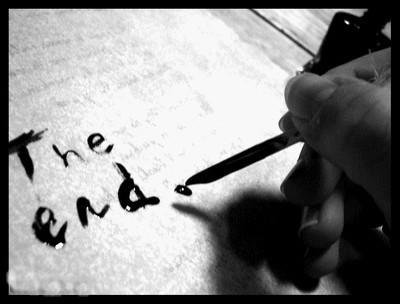
... The End

I have finished chapter 16 out of 20 of my book. The last chapters are outlined. It’s time to figure out how to write the end. HELP! 

I read four articles online about writing endings. Two of them are about general writing and two are specific to Romance. You can find links to the four articles at the end of this blog. I recommend you read them all, but here are the highlights (Now we'll see how well, I put them to use)


Your beginnings will hopefully hook the reader, but your endings can bring them back for more. That last impression will stay with them.

What your Ending should be:
  1. If you are writing romance, the ending must be Happy (HEA: Happy Ever After) 
  2. Endings are like desert. They leave your readers satisfied and happy, so they won’t feel cheated or that they wasted their time reading your book.
  3. Make the endings satisfying enough to make up for the depths to which you dragged your characters earlier. Match the emotional intensity of your conflict to that of your conclusion.
  4.  Tie up loose ends. Resolve the conflict.
  5. Know what your ending is going to be from the beginning, so it uses the emotions, personalities, etc. of the characters, as they already exist or as they have developed during the story.
  6.  Don’t explain, including letting characters explain to each other. Show, don’t tell.
  7.  Make that last line really special. “Tomorrow is another day.”  Endings do not have to illustrate a moral, but they can if you want them to. Sometimes they can tie up the overriding theme of the story. Here are some suggestions for last lines:
  •  Rewrite or evoke the first sentence in some way
  •  Try to reflect the overall emotion that your story conveys. If it’s all about marriage, maybe use a proposal….
  • Have the last sentence imply the theme.
  •  Let the last sentence explain or reiterate the title.

What your ending should NOT be:
  1. Anti-climax.  Don’t peak your novel too soon and run out of steam at the ending. Make the last scene the most intense and the most memorable. If the reader isn’t experiencing emotion, you haven’t done your job.
  2. Runaway train. Don’t catch you reader off-guard by not leading up to and setting up the end. Plan your ending and keep it in mind as you write your story. Don’t just “tack it on” at the end. The length of your ending should be proportionate to the length of your story. Try making them almost get there, then let a minor conflict drag out the satisfying climax (Like I always say, it’s like sex, folks.)
    Work on timing. When should the end start? Remember that sometimes you need something to clean the palate between the main course and dessert.
  3. Contrived:   On the other hand, don’t force your characters to follow your outline. I like outlines, but you have to let your characters grow and become themselves if they and your story are to be believable. (And sometimes you might not like what they choose to do, but deal with it.)Don’t depend on an outside force  or coincidence for the change that resolves the story.
  4. Developmental:  The same writing style might not work in every part of your story. By the end, your readers should understand your characters and their world.
    Don’t introduce complex new concepts or character traits at the end. Keep it simple and emotional. Shorten your sentences.
    Leave out the metaphors and new characters.
    Don’t let your lovers start uttering sappy phrases that they’d never have used earlier. Keep them in character.
    Don’t cheat your readers by digging up something new out of thin air. You must build to a climax. (sex again)
  5. Dribble out: Don’t forget to give your story an ending, or your readers will not feel they’ve gotten their money’s worth.

 Epilogues: Denouement or the final comment.

  1.  Epilogues can be good. After the climax, they leave the reader with a sense of closure, which can be enhanced by changing locale, pacing, or level of tension.
  2.  In the romance novel, the reader needs to be assured that the couple will work everything out and stay together.
  3.  Don’t drag it out too long. Give a quick overview of what the future holds. Show, don’t tell.

Don’t be afraid to rewrite your ending several times and ways to see which works best.


Links:


•http://www.thewritertoday.com/2009/03/pointers-on-writing-effective-endings.html


The British Pan


I am currently reading The Goat Foot God. I keep thinking that Hugh, the main character, reminds me of Mr. Toad in Wind in the Willows, running about in his motor car with his leather coat and cap. In this book, he had just found out that his deseased wife had always had a lover, so he plans to fill his empty life with a search for the Greek god, Pan.

Then I saw today that a usually omitted chapter of Wind and the Willows is the talk of England. And...guess what...it's about Pan. Hugh and Mr. Toad have more in common than liking to drive fast!

Both books are about desire, physical and intellectual, the need to travel, to stimulate the senses, to experience life. I'm thrilled to find this connection, so I found the chapter online and read it. Mole and Rat see Pan and worship him, then the demi-god erases the memory from them so the beauty of it won't spoil the rest of their lives and " all the after-lives of little animals."
http://www.literaturepage.com/read/windinthewillows-77.html

`O Mole! the beauty of it! The merry bubble and joy, the thin, clear, happy call of the distant piping! Such music I never dreamed of, and the call in it is stronger even than the music is sweet! Row on, Mole, row! For the music and the call must be for us.'

I have two reasons to be facinated by this story.  First, my son was in the play, Wind in the Willows when he was very young, and thought he'd never get a part that wasn't "a small furry animal." Although it was a children's production, the director drafted some adults to play the human parts and I acted as both a washer woman and a gypsy. What fun!! And yes, that chapter was left out.

Second, the reason I'm reading The Goat Food God is that I am dreaming up a fantasy book that includes a manifestation of The Green Man, which, it turns out, is the British version of Pan. I love when everything ties up neatly, don't you?


"One does not argue about The Wind in the Willows. The young man gives it to the girl with whom he is in love, and, if she does not like it, asks her to return his letters. The older man tries it on his nephew, and alters his will accordingly. The book is a test of character. We can't criticize it, because it is criticizing us. But I must give you one word of warning. When you sit down to it, don't be so ridiculous as to suppose that you are sitting in judgment on my taste, or on the art of Kenneth Grahame. You are merely sitting in judgment on yourself. You may be worthy: I don't know, But it is you who are on trial." 
— A.A. Milne


Good Writing is Like Good Sex


I'm reading "Eight Keys to Making a Good Book Great" in RWR magazine. Would you like to follow along on one of their exercises with me?
"I know you've heard 'write what you know': Write the emotions you know, and they will give authenticity to your writing."
Funny, I've just been priding myself in writing what I know.  My current book is about Grand Lake and Tulsa Oklahoma and  about the world of people who grew up in the oil business. And yes, that's my life.  


My dad was a welder, but created components used in oil wells and pipelines. My second husband (stay with me here) was from a pipeliner family. Both he and his father had traveled the world, building pipelines that carried the oil from place to place.


My third (and final) husband is a  Reservoir Engineer.  That's the guy (or gal) who keeps track of how much oil a company has in the ground.  Very complex stuff.  Even I work for a software company that creates software for energy trading and logistics. I am a weapon of mass instruction. I help teach people how to use the program--create the lessons for use both online and in the classroom.


So yes, I'm writing about what I know, but this question threw me for a loop. Writing about the EMOTIONS I know?  Hummm.......
The first Key in the article is "Discover your story." OK. Let's go.
The article instructs you to list your three most powerful childhood memories.

 Well, there was the time , when I was very young, maybe four or five, when we found baby rabbits (yea--lived on a farm) and my Daddy threw them over into the chicken pen, where our mean rooster promptly gobbled them up. To make it worse, that rooster was the cute baby chick that a magician had pulled out of a hat and given me a few years before. Yep. True story.

 Then there was the time I killed my dog. I, my little sister and maybe some cousins were riding in the back of a pickup truck. My dad was driving. For some reason, we had to stop and back up (It was a tiny country dirt road). I was holding our boxer puppy, but he wanted to jump out, and he pulled and fought me. Finally, my arms were so tired that I (about eight years old) thought, "I can't hold on any longer," and he jumped out of the truck and was promptly run over and killed. I COULD have held on longer. I know now that I could have.

For the third memory, I'd lump several together, but prefer not to describe any of them here. What they meant to me was embarrassment that no one ever taught me how to act around people, or in society. I grew up poor in the hills of Arkansas. My parents (salt of the earth) used poor grammar and were not, themselves, comfortable with people they didn't know well, so they didn't know what to teach me.  

What emotions did these three experiences evoke?  

Maybe the first evoked horror, but also taught me that life is complex. The rooster who had started out so cute and cuddly turned into a monster that chased me around and ate baby bunnies.  We ate that rooster soon after that incident, with my complete approval. And my Daddy, who'd chosen to feed him the bunnies. Well, I still loved him after the horror he'd put me through. Life is complex.

The second experience taught me firm determination, the value of never, ever giving up.  You don't let go, even when you think you can't take another second. You save yourself when your car goes into a skid. You finish grading those papers even if you don't sleep a wink. You FIND a way to send your son to that expensive college.  You don't spare yourself and you don't give up.

The third experiences? Well, humbleness, and also determination again. I read tons of books growing up, and lived in other people's heads and worlds. I learned early that life offered more, but I'd have to reach for it. I determined to teach myself how to be comfortable out in the world.  Even though I almost (abd) completed a Ph.D. in English, I still have to watch the way I speak. Hopefully, my son is much more comfortable in the world than I will ever be.

Was there a common emotion that each experience evoked?  I'm not sure. From them I learned acceptance and determination.  Is it an emotion that makes you grit your teeth and dig in when you could give up?  Is it an emotion that makes you look forward, not backward or to try not to judge others? It's something.

The next step in our exercise is asking what book I've written that was easiest to finish, who was the most compelling character and what are his or her five strongest characteristics (focusing on emotions). Well, I haven't quite finished my first book, but I'm choosing it. 

In my book, my most compelling character is the heroine, Hadley.  She is impulsive, open to life, goal driven, and confused by her upbringing. I guess, in some ways, that describes me too.  My character starts out thinking life is not terribly complex and that her mother had settled into a comfortable life where denying most emotions made her happy. Hadley learns a lot about her dead mother's emotions...and her own.

But the thing that I learned from this exercise was not really this answer.  It made me think about strong emotion itself.  

I once read  that a book should be like sex.  Or like classical music. The action should swell and grow, and rise and fall, and there should be crescendos and lulls. And of course the grand finale. I realize now that emotions should do the same, maybe even more so than the action. My book is full of emotions, grief, desire, curiosity, fear, joy, as Hadley learns about her mother and herself. 

I didn't think much about the pattern until I worked on this exercise. Now I will consciously play with it, and, if this book is a success, remember to create a different rhythmical, emotional (and complex) pattern for each of my books in the future.


Free Romance Novels from Amazon

Just decided to go out there and see what's free. Here's my list:

Restoring Hope (Native American Romance Series Book 1)
by Ruth Ann Nordin


Stuck With You

Stuck With You [Kindle Edition]

Trish Jensen
Product Details
by Elizabeth Bevarly (Kindle Edition - Jun 30, 2011) - Kindle eBook
Justice Incarnate (Shadows of Justice)
by Regan Black (Kindle Edition - Nov 11, 2010) - Kindle eBook
 Speed Dating (Harlequin NASCAR)
Speed Dating (Harlequin NASCAR)
by Nancy Warren (Kindle Edition - Feb 1, 2007) - Kindle eBook

How I "met" Megan Markle

Just to be clear, I've never met the woman in person, but I did have a kind of "encounter" with her shortly after she announce...